
When discussions turn to rotor imbalance, the conversation often focuses on vibration levels, balance tolerances and correction methods.
While these technical considerations are important, they only tell part of the story.
For many manufacturers, the greatest impact of imbalance is not measured in grams or microns.
It is measured in lost production, unexpected maintenance costs, reduced equipment life and ultimately, lost profitability.
Whether operating pumps, fans, motors, turbines, spindles or other rotating machinery, imbalance can quietly become one of the most expensive issues within a production environment.
The challenge is that many of these costs remain hidden until a failure occurs.
Looking beyond vibration
Imbalance is one of the most common causes of vibration in rotating equipment.
As a rotor spins, uneven mass distribution creates centrifugal forces that increase with rotational speed. Over time, these forces place additional stress on bearings, shafts, couplings and supporting structures.
The resulting vibration may appear manageable initially, but the financial consequences can accumulate long before a machine comes to a complete stop.
The question manufacturers should be asking is not:
“Can we tolerate this level of vibration?“
But rather:
“What is this vibration costing us?“
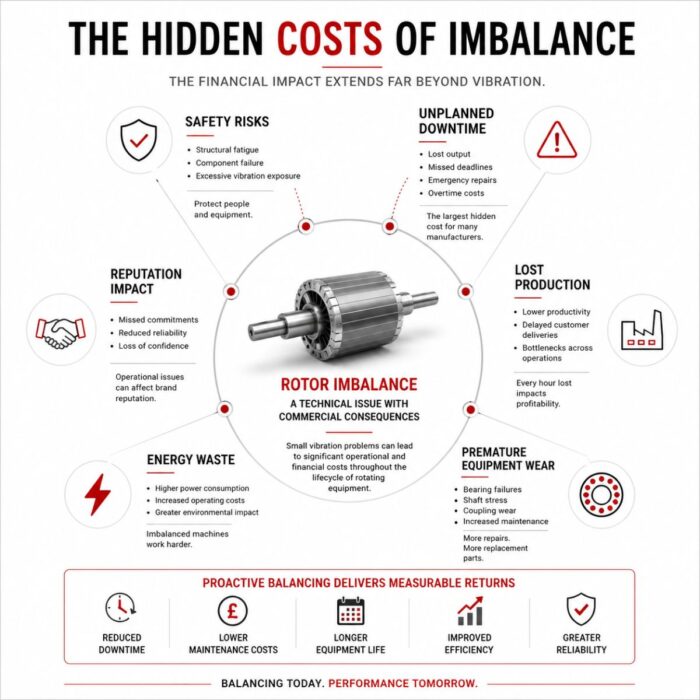
The cost of unplanned downtime
For most manufacturing operations, downtime is often the single largest cost associated with imbalance.
When critical equipment fails unexpectedly, the impact can extend far beyond the repair itself.
Organisations may experience:
- Lost production output
- Missed customer deadlines
- Overtime labour costs
- Emergency maintenance callouts
- Expedited parts procurement
- Disruption to upstream and downstream processes
In many cases, the cost of a single unplanned shutdown can far exceed the investment required to identify and correct imbalance in the first place.
The larger and more critical the machine, the greater the financial exposure becomes.
Premature bearing and component failure
Bearings are frequently among the first components affected by excessive vibration.
Although bearings are designed to withstand significant loads, continual vibration increases fatigue and accelerates wear.
The result is often:
- Reduced bearing life
- Increased maintenance intervention
- More frequent replacement cycles
- Additional labour costs
- Increased spare parts inventory
Importantly, bearings are rarely the only components affected.
Shafts, seals, couplings and mounting structures can also suffer accelerated deterioration, increasing the total cost of ownership of the equipment.
The hidden energy cost
Energy efficiency is becoming an increasingly important consideration across manufacturing and industrial operations.
However, imbalance is often overlooked as a source of unnecessary energy consumption.
When rotating equipment operates under imbalanced conditions, additional forces must be overcome during operation. This can result in:
- Increased power consumption
- Reduced operating efficiency
- Higher running costs
- Greater environmental impact
Whilst the increase may appear small on an individual machine, the cumulative effect across multiple assets operating continuously can become significant over time.
For organisations focused on reducing operational costs and improving sustainability, balancing can play an important supporting role.
Safety risks cannot be ignored
Beyond financial considerations, excessive vibration can create genuine safety concerns.
Persistent vibration can contribute to:
- Mechanical failures
- Component detachment
- Structural fatigue
- Increased operator exposure to vibration
- Potential secondary equipment damage
In extreme cases, imbalance-related failures can pose risks to personnel, equipment and surrounding infrastructure.
For this reason, addressing imbalance is not simply a maintenance issue, it is also a risk management issue.
The impact on reputation and customer confidence
Equipment failures do not only affect internal operations.
When downtime leads to delayed deliveries, reduced product quality or missed commitments, customer relationships can also be affected.
Manufacturers work hard to build reputations based on reliability and consistency.
Repeated operational disruptions can undermine that reputation and erode customer confidence over time.
While these costs are difficult to quantify precisely, they can be among the most damaging in the long term.
Understanding the return on investment
One reason balancing initiatives are sometimes delayed is because they are viewed as a maintenance expense rather than a business improvement opportunity.
In reality, balancing often delivers value across multiple areas simultaneously.
Potential returns may include:
- Reduced downtime
- Lower maintenance costs
- Extended equipment life
- Reduced spare parts consumption
- Improved energy efficiency
- Greater production reliability
- Improved product quality
When viewed collectively, these benefits can often justify investment in balancing services, condition monitoring programmes or balancing equipment.
A simple way to assess potential value is to consider:
What would a single day of unexpected downtime cost your business?
For many organisations, the answer provides a compelling argument for a more proactive approach.
Moving from reactive to proactive maintenance
Historically, many businesses have addressed imbalance only after vibration becomes excessive or a failure occurs.
However, modern maintenance strategies increasingly focus on prevention rather than reaction.
Combining dynamic balancing with technologies such as vibration analysis and condition monitoring allows potential issues to be identified before they develop into costly failures.
This enables maintenance teams to:
- Plan interventions more effectively
- Reduce emergency repairs
- Improve equipment availability
- Optimise maintenance budgets
- Increase operational confidence
The result is a more predictable and reliable production environment.
Final thoughts
Rotor imbalance is often viewed as a technical issue, but its consequences are fundamentally commercial.
The true cost extends far beyond vibration readings and maintenance reports.
It affects productivity, profitability, energy consumption, asset life, safety and customer satisfaction.
By understanding the wider business impact of imbalance, manufacturers can make more informed decisions about maintenance strategies and investment priorities.
In many cases, the cost of correcting imbalance is small compared to the cost of ignoring it.
How CEMB Hofmann UK can help
CEMB Hofmann UK supports manufacturers across a wide range of industries with balancing machinery, sub-contract balancing services, vibration analysis and condition monitoring solutions.
Whether you are looking to improve equipment reliability, reduce downtime or develop a more proactive maintenance strategy, our team can help identify the most appropriate solution for your application.