
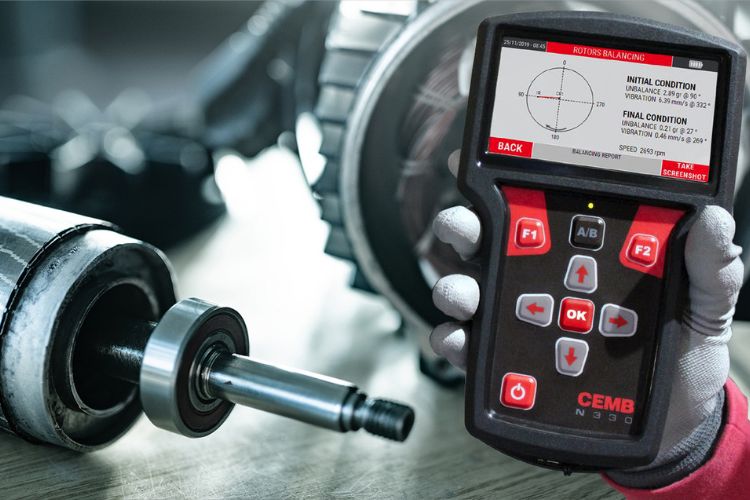
How to reduce ongoing maintenance costs through smarter preventative strategies
In industrial environments, ongoing operational costs rarely spiral overnight. Instead, they creep up gradually, usually through unplanned downtime, premature component failure, reactive maintenance callouts, and reduced energy efficiency.
One of the most effective ways to control these costs is by integrating vibration analysis into a structured preventative maintenance programme.
At CEMB Hofmann UK, we work with engineering, manufacturing, utilities and process-led businesses across the UK to help them monitor, diagnose and resolve machinery issues before they escalate. This article outlines how vibration analysis reduces operational expenditure, and why it is increasingly considered essential within modern maintenance strategy.
The cost of reactive maintenance
Many organisations still rely heavily on reactive maintenance: waiting until a machine fails before investigating the cause.
While this approach may appear economical in the short term, it often results in:
- Emergency callout fees
- Overtime labour costs
- Production downtime
- Collateral damage to adjacent components
- Reduced equipment lifespan
A single bearing failure in a high-speed rotating asset can lead to shaft damage, misalignment, or even catastrophic machine failure if left unchecked. The financial impact can extend well beyond the cost of the replacement part.
Preventative maintenance aims to interrupt this cycle, and vibration analysis is one of the most powerful tools available to achieve this.
What is vibration analysis?
Vibration analysis involves measuring the oscillatory motion of rotating machinery to detect abnormalities in performance. Every rotating component, motors, pumps, fans, gearboxes, turbines, produces a vibration signature. When a defect begins to develop, that signature changes.
Using precision measurement equipment and software, engineers can detect:
- Bearing wear
- Imbalance
- Misalignment
- Mechanical looseness
- Gear mesh issues
- Structural resonance
- Electrical faults (in some motor applications)
Crucially, vibration analysis identifies issues at an early stage, often long before temperature rises or audible noise becomes apparent.
How vibration analysis reduces ongoing costs
1. Early fault detection prevents escalation
Minor imbalance or bearing wear, if detected early, can be corrected at minimal cost. Left unresolved, the same issue can:
- Increase vibration amplitude
- Accelerate wear
- Damage connected components
- Trigger unplanned shutdowns
By intervening early, businesses avoid the compound cost of failure.
2. Extends asset lifespan
When rotating machinery runs smoothly and within tolerance, stress on components is significantly reduced. Lower stress means:
- Longer bearing life
- Reduced shaft fatigue
- Improved seal performance
- Lower likelihood of cracking or structural fatigue
This translates directly into reduced capital expenditure over time.
3. Reduces unplanned downtime
Downtime is often the most expensive consequence of equipment failure, particularly in high-throughput production environments.
Scheduled maintenance informed by vibration data allows interventions to be planned during routine shutdowns rather than during peak production. Planned work is always more cost-effective than emergency repair.
4. Optimises maintenance intervals
Traditional maintenance schedules are often time-based (e.g. inspect every six months). However, not all machinery degrades at the same rate.
Condition-based monitoring using vibration data enables maintenance to be:
- Performed when required
- Avoided when unnecessary
- Targeted to specific assets
This avoids both under-maintenance (risk) and over-maintenance (waste).
5. Improves energy efficiency
Imbalanced or misaligned rotating equipment consumes more energy. Even minor mechanical inefficiencies can increase power consumption across a plant.
Correcting imbalance or alignment through data-led intervention improves mechanical efficiency, reducing energy costs and supporting sustainability targets.
From measurement to action
Identifying vibration is only the first step. Interpreting the data accurately and applying corrective measures is where experience matters.
As the UK representative of CEMB S.p.A., with over 80 years of balancing heritage globally and nearly three decades of UK representation, we support customers with:
- Portable vibration measurement solutions
- Permanent monitoring systems
- Diagnostic analysis
- Dynamic balancing services
- In-house and on-site corrective balancing
- Training and technical support
Our approach is educational and consultative. We focus on helping maintenance teams understand the data so that they can make informed decisions aligned with operational priorities and budgets.
Vibration analysis vs. balancing — understanding the relationship
Vibration analysis identifies the presence and source of abnormal vibration.
Dynamic balancing corrects mass distribution issues that cause imbalance.
Used together, they form a powerful preventative maintenance partnership:
- Vibration analysis detects the issue
- Balancing resolves it
- Ongoing monitoring verifies performance
Integrating both disciplines into a maintenance programme provides a structured, repeatable pathway to reducing lifecycle costs.
Making the business case
For many organisations, the decision to invest in vibration monitoring is financial rather than technical.
When building the case internally, consider:
- Cost of a single unplanned shutdown
- Replacement cost of critical assets
- Labour costs of emergency repair
- Energy consumption trends
- Health & safety implications of catastrophic failure
Even modest improvements in reliability often deliver measurable ROI within a short period.
A smarter preventative maintenance strategy
Preventative maintenance is evolving. The most effective programmes today are data-driven, condition-based and strategically aligned with operational performance.
Vibration analysis provides measurable insight into the health of rotating machinery, enabling maintenance teams to act with precision rather than assumption.
For engineering and manufacturing businesses seeking to control ongoing operational costs, improve reliability and extend asset life, integrating vibration analysis is not simply a technical upgrade. It is a strategic decision.