
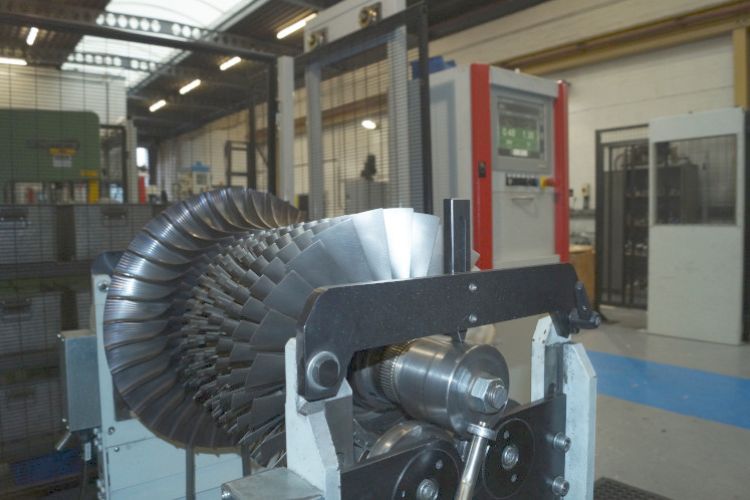
Bringing a rotating product successfully to market often requires countless decisions around design, materials, performance, manufacturability, cost and reliability. Yet one critical factor can sometimes receive attention later than it should: dynamic balancing.
Whether developing an electric motor rotor, fan assembly, pump impeller, spindle, turbine component or precision rotating part, balance performance can have a major impact on how a product performs in the real world. Excess vibration, noise, premature wear and reduced efficiency can often be traced back to imbalance.
The most successful manufacturers understand that balancing should not be viewed as a final production-stage task alone. Instead, it should be considered throughout the full product development lifecycle, from concept and prototype through to pilot runs and volume manufacture.
Early attention to balancing can help reduce redesign costs, improve product reliability and accelerate the path to production.
Why balancing matters in product development
Any rotating component contains mass. If that mass is not distributed evenly around the axis of rotation, centrifugal forces are created during operation. As rotational speed increases, so too can the effects of imbalance.
This may lead to:
- Increased vibration
- Excess operational noise
- Bearing and shaft wear
- Reduced machine lifespan
- Lower energy efficiency
- Poor user experience
- Product failures in service
- Warranty claims and reputational damage
For engineers and manufacturers, addressing these risks early is far more cost-effective than correcting them later.
The four stages of product development balancing
Successful rotating products rarely move straight from concept to mass production without refinement. Between the first idea and full commercial manufacture lies a structured development journey, where design decisions are tested, processes are improved, and performance is validated. Balancing plays an important role at every point.
The graphic below highlights the four key stages where balancing input can reduce risk, improve reliability, and support a smoother route to market.
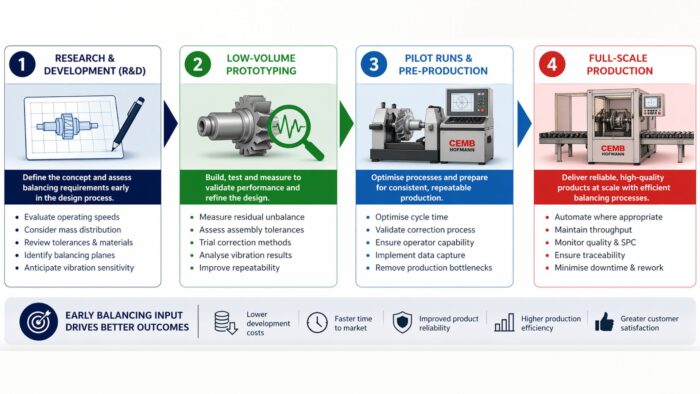
Stage 1: Research & development (R&D)
During the R&D phase, the focus is often on proving a concept, achieving performance targets and validating functionality. However, this is also the ideal stage to begin assessing balancing requirements.
Key considerations:
- Expected operating speeds
- Rotor geometry and mass distribution
- Material selection and tolerances
- Mounting methods and shaft interfaces
- Single-plane or two-plane balancing needs
- Vibration sensitivity of surrounding systems
By involving balancing expertise early, design teams can identify potential issues before tooling is commissioned or prototypes are finalised.
The benefit:
Minor design adjustments at this stage can be simple and inexpensive. Later in the process, the same issue may require costly redesign, delayed launches or production rework.
Stage 2: Low-volume prototyping
Prototype builds are where theory meets reality. Components are assembled, tested and refined under real operating conditions. This is often the first opportunity to gather meaningful vibration and balance data.
Key considerations:
- Prototype consistency between units
- Measurement of residual unbalance
- Impact of assembly tolerances
- Correction methods such as drilling, milling or adding weight
- Interaction with bearings, housings and adjacent components
Balancing prototype assemblies can reveal whether the original design assumptions hold true in practice.
The benefit:
Prototype balancing helps teams refine tolerances, improve repeatability and avoid carrying hidden issues into the next stage.
Stage 3: Pilot runs and pre-production
Pilot production is a critical bridge between engineering development and commercial manufacture. At this point, processes must become stable, repeatable and commercially viable.
Key considerations:
- Cycle time for balancing operations
- Ease of loading and unloading components
- Correction speed and repeatability
- Operator skill requirements
- Data capture and traceability
- Production bottlenecks caused by manual balancing steps
This stage often determines whether a balancing process is suitable for ongoing production volumes.
The benefit:
Balancing systems and procedures can be optimised before demand increases, helping to avoid future disruption.
Stage 4: Full-scale production
Once products enter volume manufacture, balancing becomes a productivity, quality and cost-control issue as much as an engineering one.
Key considerations:
- Automated or semi-automated balancing solutions
- Throughput requirements
- Integration with production lines
- SPC and quality monitoring
- Repeatability across large batches
- Downtime minimisation
- Documentation for customers or regulated industries
At this stage, even small inefficiencies repeated across thousands of units can become significant costs.
The benefit:
Well-planned balancing processes support consistent quality, reduced scrap, faster output and stronger customer confidence.
The cost of leaving balancing too late
When balancing is only addressed near launch or after production has begun, businesses can face:
- Tooling modifications
- Product redesign costs
- Delayed time to market
- Increased scrap or rework
- Field failures
- Higher warranty claims
- Damage to brand reputation
In many cases, these problems were preventable through earlier consideration.
Balancing as part of design for manufacture
Modern product development increasingly embraces Design for Manufacture (DFM) and Design for Assembly (DFA) principles. Balancing should sit comfortably within that same mindset.
Questions worth asking early include:
- Can this component be balanced efficiently at scale?
- Is there a practical correction location?
- Will tolerances create variability?
- Is the target balance grade realistic for production volumes?
- Will balancing need to be manual, semi-auto or automatic?
By treating balancing as a design consideration rather than an afterthought, businesses can make smarter commercial decisions.
Supporting innovation with practical expertise
Many manufacturers have strong internal engineering teams but may not handle balancing requirements every day. External balancing specialists can provide valuable support during development projects, whether advising on process feasibility, prototype balancing or specifying production machinery.
From first concept through to full production, balancing can influence performance, durability, efficiency and customer satisfaction.
The earlier it is considered, the easier and more cost-effective it is to manage.
For manufacturers developing rotating products, balancing should not simply be the final box to tick before shipment. It should be part of the journey from prototype to production.
How CEMB Hofmann UK can help
We support manufacturers with balancing machinery, technical expertise and sub-contract balancing services across a wide range of industrial applications.
Whether you are refining a prototype, preparing for pilot production or reviewing an existing manufacturing process, our team can help you identify the right balancing solution for each stage of development.